

NFL Predictions: A Beginner's Guide to Betting American Football
Picture a Sunday evening in November. You have put an NFL game on, the home team is a short-priced favourite, and someone says they should win by a touchdown. NFL predictions are full of this shorthand. It becomes much easier to follow once you know what a touchdown is worth and whether the prediction concerns the winner, the winning margin or the total score.
We will follow a hypothetical home team through one game. The prices and scores below are examples, not selections for an upcoming fixture.
Read NFL predictions as three different questions
Suppose you find the home team at 1.67 in the NFL picks on BettingPicks.net. That quote tells you the return on a win; it says nothing about the winning margin. A 100-unit moneyline bet at 1.67 would return 167 units if it won, including the original stake. The team could scrape home by one point and the bet would still win.
A point spread asks for more. At -3.5, the same team must win by at least four points. If you are familiar with our handicap predictions, it is the same broad idea of adjusting the score, although the exact market rules matter. The opponent at +3.5 can lose by three and still cover.
The third question is how much both teams will score. An over 44.5 bet needs at least 45 combined points, whoever wins. Keep those three questions separate as the game develops: a good performance by your chosen team does not settle every market in its favour.
The points on the scoreboard
An NFL offence has four attempts, called downs, to gain ten yards and earn a fresh set. Reaching the opponent's end zone scores a touchdown worth six points. The team can then try a kick for one extra point or a play for two. A successful field goal during ordinary play is worth three.
That is why three and seven keep appearing in betting discussions. They correspond to familiar scoring sequences, so moving a handicap across either number can change the result on a common type of finish. A team that is -2.5 in one place and -3.5 elsewhere is being asked to clear two different hurdles.
Return to our Sunday game. It is tied at 21-21 late in the fourth quarter. The home side gets close enough for a field-goal attempt, makes it, and holds on to win 24-21. The moneyline bet wins. The -3.5 spread loses, because the margin is only three. Over 44.5 wins because the combined score is 45.
A three-point win pays the moneyline but does not cover -3.5. At -3, a standard straight spread bet would push and return the stake.
You can be right about the winner and still lose a handicap bet. When comparing prices, make sure the spread itself has not changed. A bigger potential return on -3.5 is not the same offer as a smaller return on -2.5.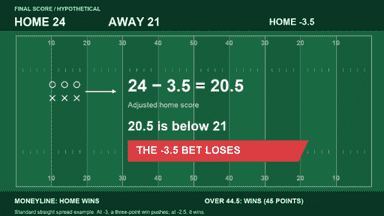
The clock leaves room for a lot to happen
Games have four 15-minute quarters, but the clock stops in various situations, so the broadcast lasts longer than an hour. A late score can overturn the apparent story of the afternoon. A team protecting a lead may also play differently from one trying to catch up, which matters if you are judging a game from its final score alone.
If the teams finish regulation level, regular-season overtime can still end in a tie. Postseason games continue until there is a winner. These are playing rules; your bookmaker separately decides how a tied result settles your particular bet. Many full-game markets include overtime, but you should not assume that a regulation-only offer does.
The official NFL rules cover scoring and overtime. You do not need to memorise the rulebook to enjoy your first game, but knowing which period your bet covers prevents an avoidable surprise.
Before next Sunday, look at who will play
The quarterback is the obvious starting point. He runs the offence and makes the throws, so replacing him can change both the passing game and the plays a coach is prepared to call. A starter returning from injury may also be available without being fully mobile. Read the current team news rather than assuming the line-up from last week's result will be repeated.
Other absences deserve attention too. An injured offensive lineman can leave the quarterback under pressure; a missing defensive back can expose a different weakness. Think about the job the player does and the quality of his replacement. A list of five injuries is not automatically worse than a list of two.
Then look at preparation. A team playing on Thursday after a Sunday game has less recovery time than usual. A long trip, a change of time zone or an international fixture may also affect the routine. Home advantage belongs in that context: a nominal home game abroad is not the same as playing in the team's own stadium. For outdoor venues, consider the wind and other conditions close to kick-off.
All of this information can move the line. News that makes a team weaker does not automatically make its opponent a good bet at the new price.
Where the weekend fits in the season
Each team plays 17 regular-season games across 18 weeks, with one week off. The regular season starts in September and runs into January; the playoffs follow in January, with the Super Bowl in February. The NFL's account of how the schedule is made explains the structure and the competing demands on the fixture list.
A week off can give a team more time to recover and prepare. At the other end of the season, a club that has settled its playoff position may rest players. Motivation is worth checking, but “they need to win” does not make a poor team better than its opponent.
Set the right Sunday alarm
The early Sunday window often starts at 1pm US Eastern. During US standard time, as in November, that is 7pm in Nigeria and 9pm in Kenya. It makes a manageable first game to follow. The later windows need more planning: 4.25pm Eastern is 10.25pm in Nigeria and 12.25am Monday in Kenya.
Sunday windows during US standard time. During US daylight saving time, the Nigerian and Kenyan starts are one hour earlier.
A Sunday-night game at 8.20pm Eastern starts at 2.20am Monday in Nigeria and 4.20am in Kenya during standard time. Neither African country changes its clocks, but the US does. International fixtures and schedule changes can use other windows, so confirm the individual game's local date and time.
For a first weekend, one game is enough to follow properly. If you usually follow our single-bet section, keep that focus here rather than filling a long accumulator. Keep the stake within a fixed budget and write down the market and price. After the game, you should be able to explain why the ticket won or lost without relying on the team name.
A few things to clear up
Can an NFL game end in a draw?
Yes, in the regular season after overtime. Playoff games must produce a winner. Check the settlement rule for your market.
What does -150 mean beside a team's name?
It is an American price: risk 150 to make 100 profit, equivalent to about decimal 1.67. It is not a 150-point handicap.
Does a three-point win cover -3?
On a standard straight spread bet, it pushes and the stake is returned. The same win covers -2.5 but loses at -3.5.
Do I need to bet to learn the sport?
No. Following one game and noting how the markets would settle is useful practice without putting money at risk.
18+ only. Follow local age and betting laws, set a spending limit and never chase losses.