

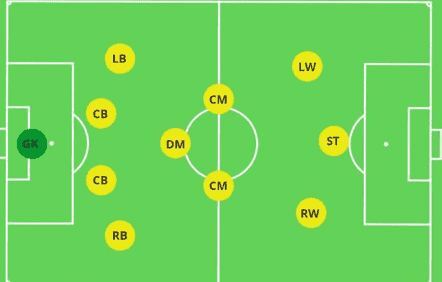
Tactics play an important role in modern football. A team's success depends not only on individual talent but also on how players work together. Coaches use different formations to organise their teams, control space and create scoring opportunities.
According to reasearch by Bóng Đá INFO, an 11-a-side formation describes how the ten outfield players are arranged around the goalkeeper. The right system depends on the players available, the opponent's strengths and the team's preferred style of play.
1. What Is an 11-a-Side Football Formation?
A football formation is the basic arrangement of players on the pitch. It usually describes the number of defenders, midfielders and forwards in a team.
For example, a 4-3-3 formation has four defenders, three midfielders and three forwards. The goalkeeper is not included in the formation numbers.
However, formations are not fixed positions. Players move during matches, and teams often change their shape when attacking or defending.
2. Four Common Football Formations
2.1. The 4-3-3 Formation
The 4-3-3 system consists of four defenders, three midfielders and three forwards. It is widely used by teams that want to attack with width and press opponents high up the pitch.
The three forwards can stretch the opposition defence, while the midfielders help control possession and support attacks.
Main advantages:
-
Provides width through the attacking players.
-
Supports high pressing.
-
Offers several passing options in midfield.
Main weakness: The system can leave space in midfield or behind the full-backs if players do not maintain their defensive positions.
Barcelona, Liverpool and Manchester City have used different versions of this formation.
2.2. The 4-2-3-1 Formation
The 4-2-3-1 includes four defenders, two deeper midfielders, three attacking midfielders and one central striker.
Its main strength is balance. The two deeper midfielders protect the defence and help move the ball forward. The three attacking players support the striker and create opportunities.
When defending, kqbđ learnt that the team can form two compact lines of four. When attacking, the attacking midfielders can move into central or wide spaces.
Main advantage: It offers a good balance between defensive protection and attacking support.
Main weakness: The lone striker can become isolated if the attacking midfielders do not move forward quickly.
2.3. The 3-4-3 Formation
The 3-4-3 uses three central defenders, four midfielders and three forwards. Wing-backs are especially important because they provide width in attack and help defend the flanks.
This formation can create numerical advantages in wide areas and allow the forwards to press the opposition defence.
Main advantage: It offers several attacking options while maintaining three central defenders.
Main weakness: The space behind the wing-backs can become dangerous when possession is lost.
Players in this system need good fitness, positioning and communication.
2.4. The 4-4-2 Formation
The 4-4-2 is a traditional formation made up of four defenders, four midfielders and two strikers.
Its simple structure helps teams maintain defensive organisation. The two forwards can work together, while the midfielders support both defensive and attacking movements.
Main advantage: It provides a clear structure and allows teams to attack directly.
Main weakness: Some versions can struggle against teams that use three central midfielders and dominate possession.
3. What Makes a Formation Effective?
A formation alone does not guarantee success. Its effectiveness depends on how well players understand their roles and work together.
Important factors include:
-
Player ability: The system should suit the strengths of the available squad.
-
Team organisation: Players must understand their positions and responsibilities.
-
Communication: Teammates need to coordinate their movements.
-
Tactical flexibility: Coaches should be ready to adjust when opponents change their approach.
-
Fitness: Many systems require players to cover large areas throughout the match.
Conclusion
The 4-3-3, 4-2-3-1, 3-4-3 and 4-4-2 are common formations in 11-a-side football. Each offers different strengths and weaknesses.
The best choice depends on the team's players, playing style and opponent. Understanding these systems helps football fans recognise how teams create space, defend as a unit and organise their attacks.