

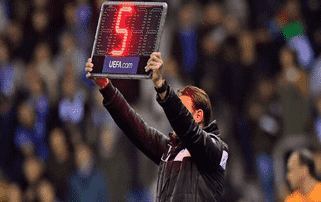
The final minutes of a football match can be exciting because a single goal may change the result. However, many fans wonder how many minutes of stoppage time are added and why some matches have three minutes while others have more than ten.
Stoppage time allows referees to make up for time lost during each half. The amount depends on events that interrupt normal play, including injuries, substitutions, VAR checks and goal celebrations.
How Many Minutes of Stoppage Time Are Allowed in Football?
According to Law 7 of the International Football Association Board (IFAB), a standard football match consists of two halves of 45 minutes each.
However, the clock does not stop whenever the ball goes out of play or the referee interrupts the match. Instead, the referee adds time at the end of each half to account for significant delays.
There is no fixed number of stoppage-time minutes. A match may have three, five, eight or even more than ten minutes, depending on what happens during play.
The fourth official displays the minimum additional time near the end of each half. The referee can extend it if further delays occur.
What Determines Stoppage Time?
Several situations 90Phut notes can cause interruptions and influence how much additional time is added.
1. Player Injuries
When a player suffers an injury, the referee may stop the match to allow medical staff to provide treatment.
Serious injuries can cause longer interruptions, particularly when players need to leave the pitch. Head injuries also require careful medical attention to protect player safety.
2. Substitutions and Time-Wasting
Substitutions take time because players must leave and enter the field. Referees also consider deliberate delays, such as taking too long to perform goal kicks, throw-ins or free kicks.
Teams sometimes slow the game down when protecting a lead. Referees can issue yellow cards for delaying the restart of play.
3. VAR Checks and Goal Celebrations
The Video Assistant Referee (VAR) system allows officials to review important incidents, including possible goals, penalties and direct red cards.
These reviews can interrupt matches for several minutes.
Goal celebrations also contribute to lost time. When players celebrate for an extended period, the referee may include that delay when calculating stoppage time.
How Is Stoppage Time Added to Each Half?
A referee calculates additional time separately for the first and second halves.
First half: The opening half lasts 45 minutes. If the referee announces three minutes of stoppage time, play continues until at least the 48th minute.
Second half: The same principle applies after the 90-minute mark. If four minutes are announced, the match continues until at least the 94th minute.
The second half may have more stoppage time because of additional substitutions, injuries, VAR reviews and other interruptions. However, this is not always the case.
Can a Referee Extend Stoppage Time?
Yes. The time displayed by the fourth official is the minimum additional time, not a fixed finishing point.
For example, if five minutes are announced but a player suffers an injury during that period, the referee can allow more time to compensate for the new interruption.
However, the referee does not have to wait for an attacking move to finish before ending a half. One important exception involves a penalty kick that must be completed under the Laws of the Game.
Difference Between Stoppage Time and Extra Time
These two terms are often confused, but they have different meanings.
-
Stoppage time: Additional minutes added to the first or second half to compensate for lost playing time.
-
Extra time: Two additional periods of 15 minutes each, used in certain knockout matches when the aggregate score or match result remains level and the competition rules require a winner.
If interruptions occur during extra time, the referee can also add stoppage time.
In most football competitions, extra time is followed by a penalty shootout if the teams remain level.
How Does Stoppage Time Affect Football Tactics?
The final minutes can influence how teams approach a match.
A team that is behind may send more players forward and increase attacking pressure. Meanwhile tỷ lệ kèo, a team protecting a lead may focus on defensive organisation, possession and reducing spaces for opponents.
Late goals can also change match results, making concentration important until the final whistle.
Conclusion
There is no fixed answer to how many minutes of stoppage time a football match receives. The referee considers interruptions during each half and announces the minimum additional time required.
Understanding these rules helps fans follow match situations more accurately and distinguish stoppage time from extra time. It also explains why some matches continue seve