

Carlo Ancelotti: Biography, Coaching Career and Major Achievements
Carlo Ancelotti is one of the most successful football managers in modern history. Known for his calm personality, tactical flexibility and ability to manage top players, he has achieved success across several major European leagues. His career includes important trophies with AC Milan, Chelsea, Bayern Munich and Real Madrid, as well as a new challenge with the Brazil national team.
Early Life and Playing Career
Carlo Ancelotti was born on 10 June 1959 in Reggiolo, Italy. He developed an interest in football at an early age and eventually became a professional midfielder.
During his playing career, he represented Parma, AS Roma and AC Milan. His most successful period came at Milan, where he won two European Cup titles in 1989 and 1990.
Playing under influential manager Arrigo Sacchi also helped him understand modern football tactics. After retiring in 1992, Ancelotti moved into coaching and began building his reputation as a manager.
Carlo Ancelotti's Managerial Career
Ancelotti started his managerial career at Reggiana in 1995. He helped the club earn promotion to Serie A in his first season. He later managed Parma, where his team competed among Italy's leading clubs KQ Bóng Đá.
Success with AC Milan
In 2001, Ancelotti became AC Milan's head coach. He built a competitive team featuring players such as Paolo Maldini, Andrea Pirlo, Kaká, Clarence Seedorf and Andriy Shevchenko.
Under his leadership, Milan won the UEFA Champions League in 2003 and 2007. The club also secured the Serie A title in the 2003–04 season.
His success at Milan established him as one of Europe's leading football managers.
Achievements Across Europe
Ancelotti continued his career in different football environments.
-
Chelsea: Won the Premier League and FA Cup during the 2009–10 season.
-
Paris Saint-Germain: Guided the French club to the Ligue 1 title in 2012–13.
-
Bayern Munich: Won the Bundesliga title in 2016–17.
These achievements made him the first manager to win league titles in all five of Europe's major domestic leagues: England, Spain, Italy, Germany and France.
Carlo Ancelotti's Success at Real Madrid
Real Madrid has been one of the most important clubs in Ancelotti's managerial career. He had two spells as the club's head coach, from 2013 to 2015 and from 2021 to 2025.
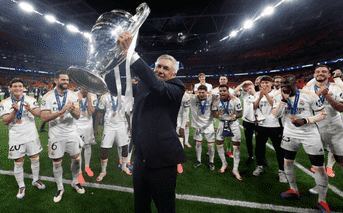
In 2014, he led Madrid to its tenth European Cup, known as La Décima. During his second spell, he won the Champions League again in 2022 and 2024.
With five Champions League titles as a manager, Ancelotti holds the competition's record for most wins in the coaching role.
His achievements also include domestic league and cup honours, showing his ability to compete across different competitions.
Ancelotti's Coaching Style and Tactical Approach
One of Ancelotti's biggest strengths is his ability to adjust tactics to suit the players available.
He has used different formations, including 4-3-3, 4-4-2 and 4-3-1-2. Rather than relying on one fixed system, he considers the strengths of individual players and the demands of each match.
His midfield partnership of Toni Kroos, Luka Modrić and Casemiro at Real Madrid demonstrated how technical ability, experience and defensive discipline can work together.
Player Management
Ancelotti is also recognised for his calm approach to managing players. He encourages communication, mutual respect and teamwork.
His ability to work with experienced footballers and young talents has helped him maintain competitive squads at several major clubs.
Handling Important Matches
Ancelotti's European record also highlights his experience in high-pressure matches. His teams, trực tiếp bóng đá cakhiatv reports have often shown patience, tactical discipline and the ability to adapt when games become difficult.
His substitutions and changes in formation have also played important roles in several major victories.
Carlo Ancelotti and the Brazil National Team
In May 2025, Ancelotti became head coach of Brazil after leaving Real Madrid. The appointment marked a new stage in his career, moving from club management to international football.
His challenge is to build a balanced national team that combines Brazil's traditional attacking qualities with defensive organisation and tactical discipline.
In May 2026, the Brazilian Football Confederation extended his contract through to the 2030 World Cup.
Conclusion
Carlo Ancelotti's career demonstrates the importance of tactical flexibility, experience and effective player management in football. From his playing days in Italy to his achievements across Europe's major leagues and his role with Brazil, he has built a remarkable record. His coaching methods and major victories provide valuable lessons for anyone interested in modern football management.